
The Founder
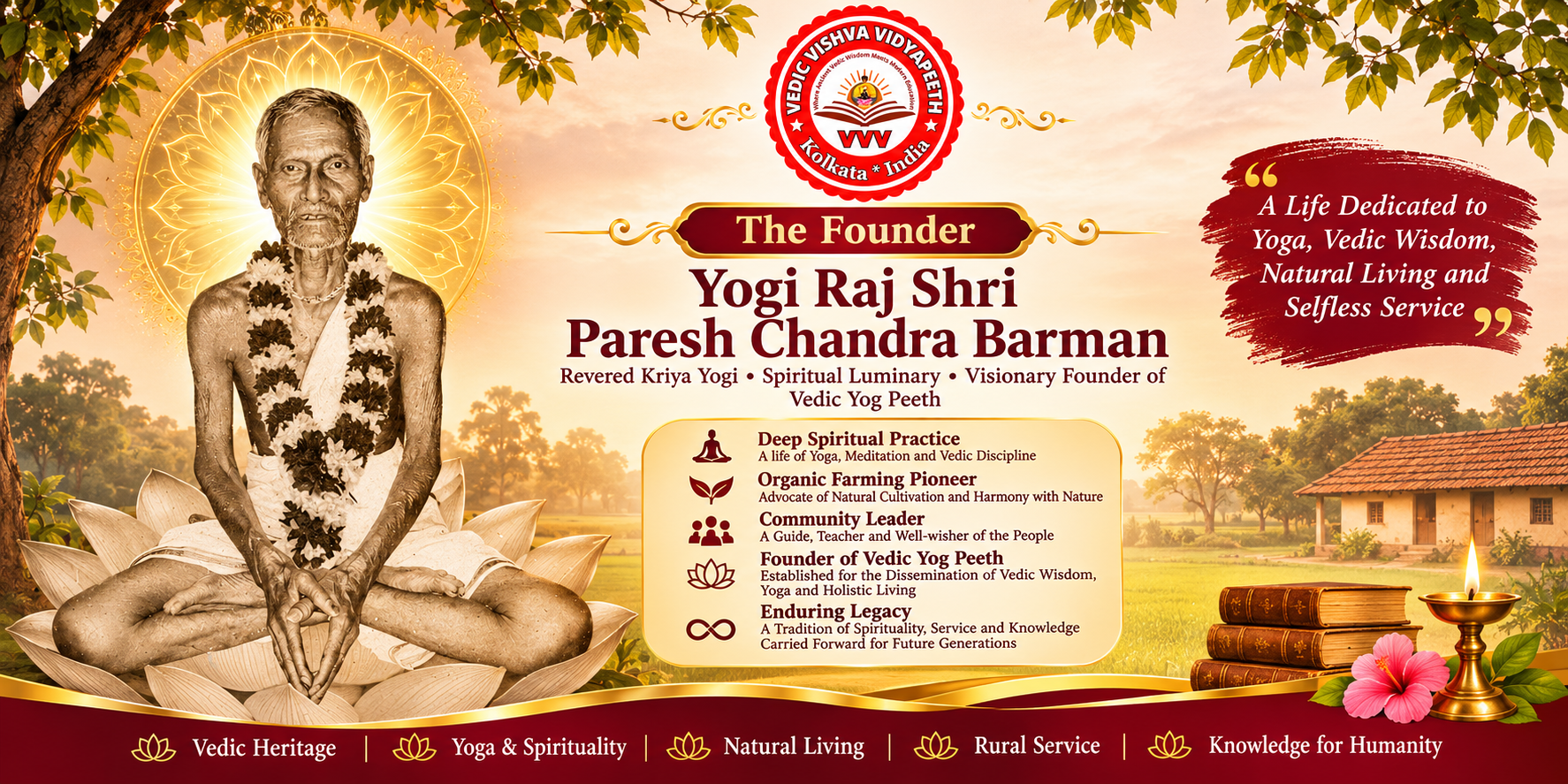
Yogiraj Shri Paresh Chandra Barman
THE FOUNDER
Yogiraj Shri Paresh Chandra Barman
The Spiritual Visionary Behind the Foundation of Vedic Yog Peeth
A Life Dedicated to Yoga, Vedic Wisdom, Nature and Selfless Service
The history of Vedic Yog Peeth is deeply connected with the life, spiritual dedication and visionary ideals of its founder, Yogi Raj Shri Paresh Chandra Barman, a revered Kriya Yogi and spiritual practitioner whose life was devoted to yoga, meditation, Vedic culture, natural living and the welfare of society.
Born in Bangladesh in the early 1920s, Shri Paresh Chandra Barman later migrated to West Bengal, India. His life journey reflected a deep commitment to spiritual discipline, simplicity, self-reliance and service to humanity. Guided by his faith in yogic principles and the wisdom of India's ancient traditions, he sought to create an environment where spiritual knowledge, disciplined living and community welfare could flourish together.
He believed that yoga was not merely a collection of physical postures or techniques, but a way of life – a continuous journey towards self-discipline, inner awareness, harmony with nature and spiritual realisation.
Through his personal practice, teachings and community engagement, he laid the foundation of an enduring tradition that continues to inspire the work of Vedic Yog Peeth.
1. A Life of Spiritual Discipline and Kriya Yoga
Yogi Raj Shri Paresh Chandra Barman was deeply devoted to the practice of yoga, meditation and spiritual discipline. His daily life reflected the importance of consistency, self-control, simplicity and dedication to one's spiritual path.
As a Kriya Yogi, he maintained a strong commitment to inner practice and the cultivation of spiritual awareness. His approach to life was rooted in the understanding that true development begins within the individual.
For him, spiritual progress was not measured merely by external achievements, social recognition or material possessions. It was reflected in the quality of one's thoughts, conduct, discipline, compassion and relationship with the world.
His life represented several enduring principles:
-
Sadhana (Spiritual Practice): Maintaining regularity and sincerity in yoga, meditation and inner discipline.
-
Atma-Sadhana (Self-Development): Cultivating self-awareness, restraint and the search for inner truth.
-
Simplicity: Living with humility, moderation and respect for the essentials of life.
-
Seva (Selfless Service): Sharing knowledge and supporting the spiritual and social development of others.
-
Harmony: Maintaining a balanced relationship between the individual, society and nature.
His spiritual life became the foundation of the values that would later guide Vedic Yog Peeth.
2. A Vision Rooted in Vedic Culture and Indian Wisdom
Shri Paresh Chandra Barman held a deep appreciation for Vedic culture and India's traditional systems of knowledge. He believed that ancient wisdom should not remain confined to books or historical discussions; it should be reflected in everyday life through ethical conduct, discipline, spiritual practice and responsible living.
His vision was to encourage people to understand the deeper significance of yoga and traditional knowledge as instruments of personal transformation and social harmony.
The principles that inspired his outlook included:
-
Respect for the Vedas and India's spiritual heritage.
-
The importance of yoga and meditation in everyday life.
-
Character development through discipline and ethical living.
-
Respect for teachers, elders, knowledge and traditional learning.
-
Harmony between physical well-being, mental balance and spiritual growth.
-
A sense of responsibility towards family, community and society.
He envisioned a way of life in which spiritual development and practical responsibilities could coexist. His ideals encouraged people to cultivate inner strength while remaining connected to the needs of their communities.
3. Organic Farming and Harmony with Nature
One of the distinctive aspects of Shri Paresh Chandra Barman's life was his practical involvement in agriculture and natural cultivation.
Beyond his spiritual pursuits, he possessed knowledge and experience in organic farming. He believed that soil, water, plants, animals and human life are interconnected, and that the well-being of society depends upon maintaining a respectful relationship with nature.
He practised natural cultivation methods and shared his knowledge with fellow villagers, encouraging sustainable agricultural practices and a closer connection with the land.
His agricultural outlook reflected values that remain highly relevant today:
-
Respecting the natural fertility and vitality of soil.
-
Encouraging natural methods of cultivation.
-
Avoiding unnecessary dependence on artificial agricultural inputs.
-
Promoting awareness of food quality and healthy living.
-
Understanding agriculture as a responsibility towards nature and future generations.
For him, the relationship between yoga and nature was not merely philosophical. It was something to be practised through everyday choices, including food, agriculture, lifestyle and responsible use of natural resources.
This connection between spiritual discipline and sustainable living remains an important part of the heritage associated with the founder.
4. Gohagram: A Centre of Spiritual and Community Life
In Gohgram, Galsi, Purba Bardhaman, West Bengal, Shri Paresh Chandra Barman's home developed into an important gathering place for people seeking spiritual guidance, devotional participation and traditional knowledge.
It became a space where villagers and visitors could come together for kirtan, scripture reading, spiritual discussions and the sharing of Vedic teachings.
These gatherings reflected his belief that knowledge should be shared and that spiritual development should encourage a sense of belonging, compassion and collective well-being.
The atmosphere of these gatherings was rooted in simplicity, devotion and community participation.
Through such activities, he helped create a local environment in which spiritual learning was connected with everyday life. His home was not simply a personal residence; it became a place of collective learning, devotional practice and cultural continuity.
This community-centred approach became an important part of the institutional philosophy that followed.
5. The Foundation of Vedic Yog Peeth
A Vision That Became an Institution
With a desire to preserve and disseminate Vedic wisdom, yoga and spiritual teachings, Yogi Raj Shri Paresh Chandra Barman established the foundation of Vedic Yog Peeth.
His vision was rooted in the belief that yoga and Vedic knowledge should be made accessible to people through regular practice, learning, guidance and community participation.
The foundation represented more than the establishment of a physical place. It reflected an aspiration to create a continuing tradition of knowledge and service.
Vedic Yog Peeth was envisioned as a place where:
-
Yoga and meditation could be practised with sincerity and discipline.
-
Vedic culture and traditional knowledge could be studied and shared.
-
Spiritual and ethical values could be encouraged.
-
People could learn the importance of healthy and balanced living.
-
Community participation and service could become part of everyday practice.
-
The wisdom of earlier generations could be carried forward to future generations.
The founding vision laid the groundwork for the institution's subsequent educational and cultural activities.
6. His Legacy: A Tradition Carried Forward Through Generations
The legacy of Yogi Raj Shri Paresh Chandra Barman is reflected in the continuation of the values and ideals associated with his life.
His commitment to yoga, spiritual learning, Vedic culture, natural living and community service provides the foundation for the institution's continuing identity.
Under the guidance of subsequent generations, the work associated with Vedic Yog Peeth has continued to develop, with an expanding focus on yoga education, traditional knowledge, wellness, research and cultural preservation.
Today, The Vedic Yog Peeth Trust and Vedic Vishva Vidyapeeth seek to carry forward this heritage through educational initiatives, practical training, research activities and the promotion of Indian Knowledge Systems.
The institution's present-day vision connects the founder's traditional ideals with the needs of contemporary society.
The aim is to preserve the spirit of the original vision while creating opportunities for new generations to explore yoga, Vedic philosophy, holistic wellness and the wider heritage of Indian knowledge.
7. The Founder’s Philosophy: Principles for a Meaningful Life
The life and ideals associated with Yogi Raj Shri Paresh Chandra Barman inspire a philosophy built around the following principles:
Yoga as a Way of Life
Yoga is a continuous discipline of self-development that brings greater awareness, balance and harmony to everyday living.
Knowledge with Practice
True learning becomes meaningful when knowledge is reflected in personal conduct and practical experience.
Spirituality with Simplicity
A meaningful spiritual life is rooted in sincerity, humility, discipline and simplicity.
Nature as a Living Responsibility
Respect for soil, food, water, plants and the natural environment is an essential part of responsible living.
Service as a Form of Sadhana
Helping others, sharing knowledge and contributing to society are meaningful expressions of spiritual values.
Preservation of Heritage
Traditional knowledge must be studied, documented, practised and transmitted responsibly to future generations.
8. Continuing the Founder’s Vision
The journey initiated by Yogi Raj Shri Paresh Chandra Barman continues through the educational, cultural and research-oriented activities of Vedic Yog Peeth and Vedic Vishva Vidyapeeth.
Our commitment is to honour his legacy by encouraging:
-
The study and practice of traditional and contemporary yoga.
-
The preservation of Vedic culture and Indian Knowledge Systems.
-
Research into the history and traditions of yoga in Bengal.
-
Education in yoga, naturopathy and holistic wellness.
-
Awareness of natural living and environmental responsibility.
-
Community-based learning, service and cultural engagement.
-
The documentation of knowledge for future generations.
The proposed Encyclopedia of Bengal Yoga, published by The Vedic Yog Peeth, is one of the research initiatives through which we seek to document the region's rich yogic heritage and preserve its historical and cultural contributions.
A Founder’s Legacy, A Continuing Mission
The life of Yogi Raj Shri Paresh Chandra Barman reminds us that an institution is not built only through buildings, programmes or formal structures. It is built through vision, values, dedication and the continuity of meaningful work.
His journey from Bangladesh to West Bengal, his devotion to Kriya Yoga, his relationship with nature, his service to the community and his vision for Vedic Yog Peeth remain an important part of the institution's heritage.
His legacy is not only a chapter in our history; it is an inspiration for our future.
VEDIC YOG PEETH
Honouring the Vision. Preserving the Heritage. Continuing the Mission.
From Spiritual Practice to Social Service – A Legacy Dedicated to Knowledge, Nature and Humanity.