
Yoga Bhumi of the Bengal
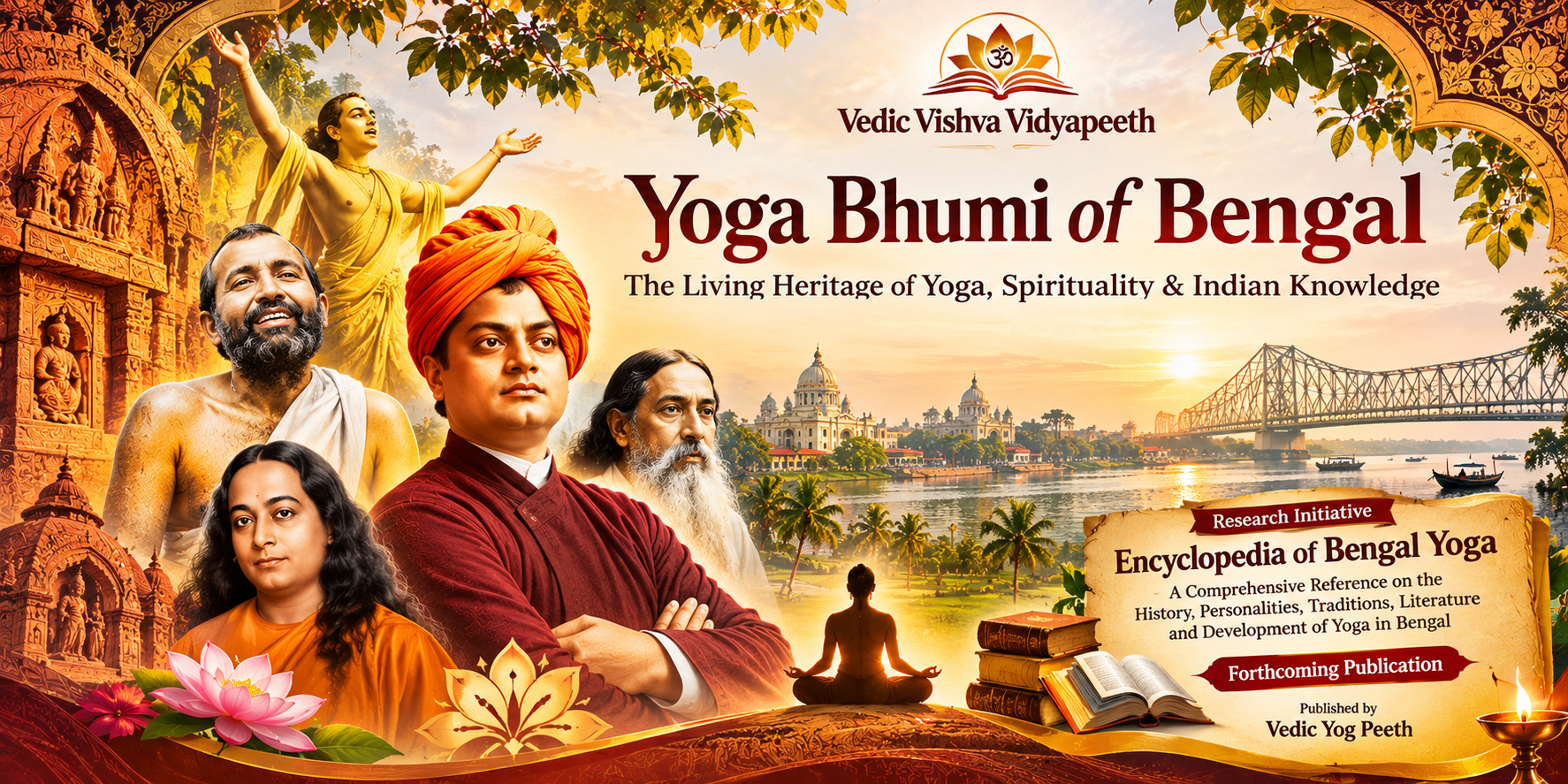
YOGA BHUMI OF BENGAL
YOGA BHUMI OF BENGAL
The Living Heritage of Yoga, Spirituality & Indian Knowledge
Introduction: Bengal – A Land of Spiritual Awakening
Bengal holds a distinctive place in the spiritual, philosophical and cultural history of India. For centuries, this region has been a fertile ground for spiritual inquiry, yogic discipline, philosophical thought, devotional movements and the pursuit of self-realisation.
From the contemplative traditions of ancient India to the Nath yogis, Tantric practitioners, Buddhist Siddhas, Bhakti saints and modern spiritual thinkers, Bengal has contributed to a diverse landscape of practices concerned with the relationship between the body, mind, consciousness and the ultimate reality.
The spiritual identity of Bengal is not confined to one school or method. It reflects a remarkable confluence of Jnana (knowledge), Bhakti (devotion), Karma (selfless action), Raja Yoga (meditation and mental discipline), Hatha Yoga (physical and energetic discipline), Tantra (spiritual practice and transformation) and other contemplative traditions.
The expression “Yoga Bhumi of Bengal” represents this rich and evolving heritage. It honours Bengal's historical contribution to India's spiritual life and recognises its continuing potential as a centre for yoga education, research, wellness and cultural preservation.
At Vedic Vishva Vidyapeeth, Kolkata, we seek to preserve, study and share this heritage through education, research, practical training and the documentation of Bengal's yogic traditions.
1. Historical Roots of Yoga in Bengal
Ancient and Early Medieval Traditions
The history of yoga in Bengal must be understood within the wider intellectual and spiritual history of eastern India. The Vedas, Upanishads, Buddhist philosophical traditions and other Indian knowledge systems developed ideas and disciplines concerning meditation, self-knowledge, consciousness, ethical conduct and liberation.
Eastern India, including the historical regions associated with Bengal, Bihar and adjoining areas, became an important landscape for Buddhist learning, monastic traditions and contemplative practices. The Pala period (approximately eighth to twelfth centuries CE) is particularly significant for the development of Buddhist intellectual and spiritual traditions in eastern India.
The Mahayana and Vajrayana traditions, including the practices associated with Buddhist Siddhas and Mahasiddhas, contributed to the broader spiritual environment in which meditation, mantra, disciplined practice and inner transformation were explored.
These traditions form an important area of historical research when studying the development and regional expressions of yoga in Bengal.
The Nath Yogis and Hatha Yoga Heritage
The Nath tradition occupies an important place in the broader history of Indian yoga and has a significant cultural and literary presence in Bengal.
Names such as Matsyendranath and Gorakhnath are closely associated with Nath yogic traditions. Their teachings and the wider Nath heritage are connected with disciplines involving the body, breath, concentration, self-control and spiritual realisation.
Bengali Nath literature, oral traditions and references to Kanphata yogis provide valuable material for studying the relationship between regional culture and wider Nath traditions.
The tradition of Kaya Sadhana – disciplined cultivation of the body as an instrument of spiritual practice – is particularly relevant to the historical study of Hatha Yoga.
Medieval Bengal: Tantra, Shaktism and Bhakti
Medieval Bengal witnessed the flourishing of diverse spiritual traditions. Shaktism, Tantra, Vaishnavism and devotional movements shaped the region's religious and cultural identity.
Tantric traditions explored mantra, meditation, ritual discipline, symbolic practices and methods of inner transformation. Bengal's Shakta heritage, especially its devotion to the Divine Mother, became an important part of its spiritual identity.
The teachings of Chaitanya Mahaprabhu (1486–1533) inspired the development of Gaudiya Vaishnavism, emphasising divine love, devotion, kirtan and surrender. Bengali devotional traditions also developed distinctive relationships between meditation, spiritual emotion and inner discipline.
Baul and Sahajiya traditions further enriched Bengal's spiritual landscape through their exploration of the human body, inner experience, music, devotion and the search for the divine within.
These traditions should be studied in their own historical and philosophical contexts, while recognising their points of interaction with broader yogic ideas.
The Nineteenth and Twentieth Centuries: The Modern Renaissance of Yoga
The nineteenth and twentieth centuries brought renewed attention to India's spiritual heritage. Bengal became an important centre of philosophical, cultural and spiritual awakening.
The teachings of Sri Ramakrishna Paramahamsa, Swami Vivekananda, Sri Aurobindo, Sri Yukteswar Giri, Paramahansa Yogananda, Swami Nigamananda Paramahansa and other spiritual personalities helped shape modern discussions of yoga, Vedanta, meditation, self-realisation and human development.
Swami Vivekananda presented the different paths of yoga – Jnana, Bhakti, Karma and Raja Yoga – to a global audience and emphasised strength, character, service and the divinity inherent in every human being.
Sri Aurobindo developed the philosophy of Integral Yoga, exploring the evolution of human consciousness and the integration of spiritual development with life.
The Kriya Yoga lineage associated with Sri Lahiri Mahasaya, Sri Yukteswar Giri and Paramahansa Yogananda also holds an important place in the study of modern yoga traditions connected with Bengal.
Together, these movements helped establish Bengal as an influential centre of modern Indian spiritual thought.
2. Great Yogis, Saints and Spiritual Thinkers Associated with Bengal
Bengal's spiritual heritage is represented by numerous teachers, philosophers and practitioners whose teachings continue to inspire seekers around the world.
Sri Ramakrishna Paramahamsa (1836–1886)
A renowned spiritual master whose life and teachings reflected the practice of devotion, meditation and the experiential exploration of different spiritual paths.
Swami Vivekananda (1863–1902)
A philosopher, spiritual leader and global ambassador of Vedanta and Yoga. His message of strength, self-confidence, service and the awakening of inner potential remains a guiding inspiration for education and human development.
Sri Aurobindo (1872–1950)
A philosopher, poet and yogi whose Integral Yoga explored the transformation of human consciousness and the possibility of spiritual evolution.
Sri Lahiri Mahasaya (1828–1895)
A major figure in the modern Kriya Yoga lineage, remembered for making a disciplined path of spiritual practice accessible to householders.
Sri Yukteswar Giri (1855–1936)
A spiritual teacher and Kriya Yoga master, known as the guru of Paramahansa Yogananda.
Paramahansa Yogananda (1893–1952)
A globally influential spiritual teacher who introduced many readers and practitioners to Kriya Yoga through his teachings and the widely read Autobiography of a Yogi. His life and teaching lineage have important connections with Bengal through Sri Yukteswar Giri.
Swami Nigamananda Paramahansa (1880–1935)
A spiritual teacher associated with eastern India whose teachings brought together aspects of yoga, Vedanta, devotion and spiritual discipline.
Paramahamsa Madhavdas Maharaj (1798–1921)
A yogic figure born in Bengal, recognised in Indian yoga education references for his spiritual life and contribution to the yogic tradition.
The lives and teachings of these personalities represent different streams of India's spiritual heritage. Their historical contexts, lineages and philosophies deserve careful study and documentation.
3. Major Yogic Traditions and Practices of Bengal
Bengal's yogic heritage is not a single system. It is a meeting point of multiple traditions, each offering distinct approaches to human development and spiritual experience.
Nath Yoga and Hatha Yoga
Associated with physical discipline, breath regulation, concentration, bodily purification and spiritual practice. The Nath tradition provides an important historical framework for studying the development of Hatha Yoga.
Tantric Yoga and Shakta Sadhana
A diverse field of spiritual disciplines involving mantra, meditation, ritual, symbolic contemplation and the worship of Shakti. These traditions require careful study of their texts, teachers and regional practices.
Bhakti Yoga and Gaudiya Vaishnavism
The path of devotion, love, surrender, kirtan and remembrance of the Divine. Chaitanya Mahaprabhu's teachings became central to Bengal's devotional culture.
Kriya Yoga
A meditative spiritual discipline associated with specific lineages and methods of practice. The Bengal connection of the modern Kriya Yoga lineage is an important subject for historical and philosophical research.
Baul and Sahajiya Traditions
Distinctive spiritual and cultural movements that explore inner realisation, the human body, music, devotion and the search for the divine within. Their relationship with yoga deserves interdisciplinary study.
Raja Yoga and Meditation
The disciplines of concentration, mental regulation, meditation and self-awareness, which are central to many Indian philosophical and yogic systems.
Yoga for Health and Physical Culture
Modern Bengali sources also document the development of yoga asanas, breathing practices, physical exercise and health-oriented instruction. This is an important area for understanding the evolution of modern yoga education in Bengal.
4. Bengal's Contribution to Modern Yoga Education and Research
Bengal's contribution to yoga extends beyond spiritual movements. The region also provides a rich field for studying modern yoga education, physical culture, health practices, literature and public engagement.
During the twentieth century, Bengali-language publications and instructional materials helped communicate yoga and physical culture to wider sections of society. The development of yoga instruction for health, the inclusion of women in yoga practice and the relationship between traditional asana and modern physical exercise are important subjects for historical investigation.
Today, yoga is studied and practised through educational institutions, traditional ashrams, wellness centres, research organisations and community initiatives.
Modern research increasingly explores the relationship between yoga and human physiology, psychology, neuroscience, biomechanics, physical rehabilitation, stress management and healthy ageing.
This creates an opportunity to bring classical yogic knowledge into meaningful dialogue with contemporary scientific inquiry, while maintaining respect for the original philosophical and practical contexts of traditional systems.
5. Vedic Vishva Vidyapeeth: Continuing the Legacy of Bengal's Yoga Heritage
Located in Kolkata, Vedic Vishva Vidyapeeth embraces the spirit of Bengal's rich yogic and spiritual heritage.
Our vision is to contribute to the preservation, academic study and dissemination of yoga and Indian Knowledge Systems through a balanced approach that respects traditional wisdom while encouraging contemporary education and research.
Our areas of educational and research interest include:
-
Vedic Yoga and Classical Yoga Philosophy
-
Hatha Yoga, Asana and Pranayama
-
Kriya Yoga and Meditation Traditions
-
Nath, Tantra and Bhakti Traditions
-
Yoga Anatomy, Physiology and Biomechanics
-
Yoga Psychology and Neuroscience
-
Yoga Therapy and Naturopathy
-
Ayurveda and Holistic Wellness
-
Sanskrit Texts and Indian Knowledge Systems
-
Bengal's Spiritual History and Yogic Literature
Through academic programmes, teacher training, practical learning, seminars, workshops, community outreach and research initiatives, we seek to encourage a deeper understanding of yoga as a discipline of personal development, health, knowledge and self-realisation.
We also recognise the importance of preserving regional knowledge, oral histories, manuscripts, biographies, traditional practices and the contributions of lesser-known teachers and institutions.
6. Research Initiative: Encyclopedia of Bengal Yoga
Documenting the Past. Understanding the Present. Inspiring the Future.
One of our important research initiatives is the preparation of the Encyclopedia of Bengal Yoga, a proposed scholarly publication dedicated to documenting the history, personalities, traditions, literature and development of yoga in Bengal.
The project aims to create a comprehensive reference work that brings together historical information, philosophical perspectives, biographical accounts, textual references and contemporary developments relating to Bengal's yogic heritage.
Proposed Research Areas
-
Historical Documentation: Early references, historical periods, regional developments and the evolution of yoga in Bengal.
-
Yogis and Spiritual Personalities: Biographical documentation of recognised yogis, saints, gurus, philosophers and spiritual teachers associated with Bengal.
-
Yogic Traditions and Lineages: Nath Yoga, Hatha Yoga, Kriya Yoga, Tantra, Bhakti, Baul, Sahajiya and other relevant traditions.
-
Texts, Manuscripts and Literature: Bengali and Sanskrit sources, traditional writings, publications, oral histories and archival references.
-
Yoga Education and Institutions: The development of yoga teaching, training centres, ashrams, educational institutions and organisations in Bengal.
-
Yoga and Health: The evolution of asana, pranayama, meditation, physical culture, yoga therapy and wellness practices.
-
Contemporary Research: Yoga biomechanics, psychology, neuroscience, physiology, therapeutic applications and interdisciplinary research.
-
Regional Heritage: Documentation of districts, local traditions, historical sites, practitioners and community contributions.
Publication
Encyclopedia of Bengal Yoga
An ongoing research and documentation initiative
Published by: The Vedic Yog Peeth
Associated Institution: Vedic Vishva Vidyapeeth, Kolkata
The forthcoming publication seeks to preserve valuable knowledge, recognise the contributions of Bengal's yogic heritage and provide a foundation for future academic research.
We welcome historical documents, authentic references, photographs, manuscripts, publications, biographies and scholarly contributions from researchers, institutions, practitioners and members of the public.
Publication is forthcoming; research, verification and documentation are ongoing.
7. Festivals, Cultural Heritage and Community Practice
Yoga in Bengal also exists within a wider cultural environment of devotion, music, festivals, seasonal celebrations and community life.
International Yoga Day, observed annually on 21 June, provides an opportunity to promote yoga education, public awareness and collective participation.
Bengal's cultural celebrations, including Durga Puja, Saraswati Puja, devotional gatherings, kirtan traditions and seasonal festivals, offer important contexts for exploring the relationship between cultural identity, devotion, mindfulness and community well-being.
Through yoga camps, seminars, workshops, awareness programmes, cultural activities and public participation, Vedic Vishva Vidyapeeth seeks to encourage the practical relevance of yoga in contemporary society.
8. Our Vision for the Future
The legacy of Bengal's yoga heritage is not only a matter of history; it is also a responsibility for future generations.
We believe that preserving this heritage requires systematic documentation, responsible scholarship, interdisciplinary research, accessible education and the active participation of communities.
Our aspiration is to contribute to a future in which Bengal's yogic traditions are studied with academic care, practised with authenticity and shared with the world through education, research and cultural exchange.
Yoga is not merely a physical exercise. It is a journey of self-understanding, discipline, harmony and the realisation of human potential.
Vedic Vishva Vidyapeeth
Preserving Bengal's Yogic Heritage. Promoting Knowledge. Inspiring Humanity.
Yoga Bhumi of Bengal – A Heritage to Preserve, A Knowledge Tradition to Explore, A Legacy to Share with the World.